


Losing a spouse is one of life’s toughest challenges. The emotional weight of grief can feel overwhelming, often pushing practical financial concerns to the back burner. Fortunately, financial planning for widows doesn’t have to be complicated or cold—it’s about taking small, manageable steps to build stability and protect yourself as you heal.
Whether you’re searching for financial steps after losing a husband, a wife, or a longtime partner, the work ahead is the same: protect what you have, claim what you’re entitled to, and give yourself room to heal. You don’t have to face any of it alone.
For help with your financial planning during this difficult time, call us today to speak with one of our ARQ Wealth advisors.
Immediate Actions: Stabilizing Cash Flow and Handling Essentials
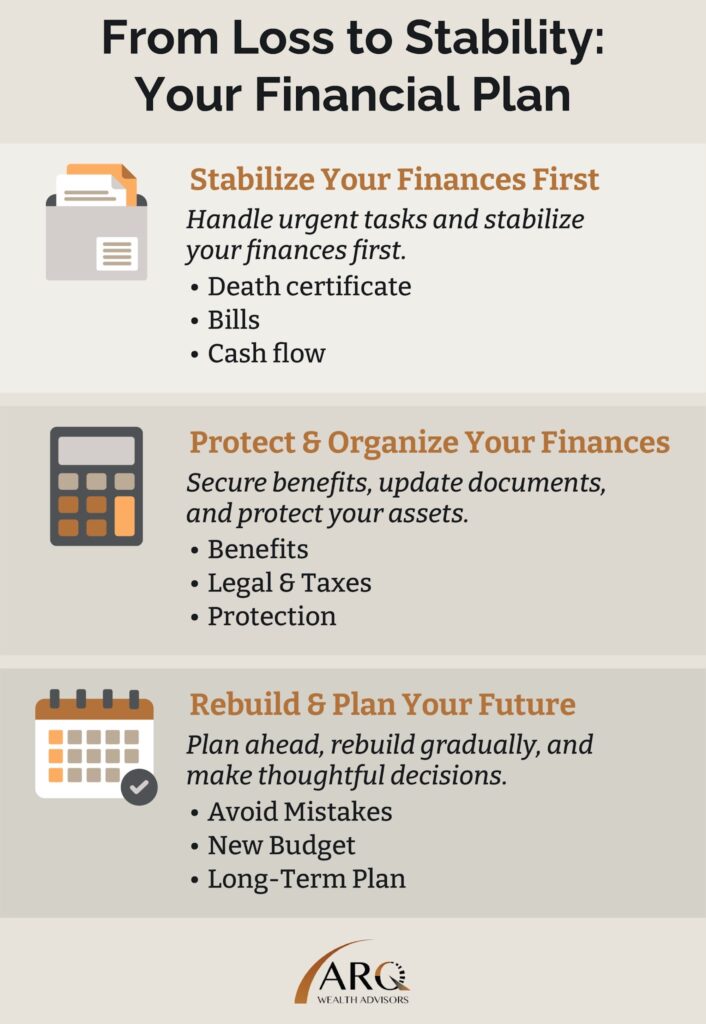
In the days and weeks after your spouse’s death, focus only on the tasks that can’t wait. Start by obtaining several certified copies of the death certificate. Having 10 to 15 copies is necessary for tasks ranging from claiming benefits to updating financial accounts. Funeral homes can often provide these quickly, or you can request them from your state’s vital records office.
Next, it’s important to assess and manage cash flow. Review joint bank accounts, credit cards, and income sources, including pensions, Social Security, and life insurance claims.
Pay urgent bills, such as the mortgage, utilities, and funeral expenses. Create a short-term budget that lists essential expenses and the liquid assets available to cover them.
If your spouse managed the finances, gather bank statements, tax returns, insurance documents, and other records to stay organized.
Notify banks, credit unions, and creditors promptly. Joint accounts may be transferred to you automatically as the survivor, but individual accounts in your spouse’s name often require probate or a beneficiary claim.
Contact key institutions promptly, including the Social Security Administration (SSA), your spouse’s employer for final paychecks and benefits, life insurance companies, and mortgage lenders.
If your spouse served in the military, check Veterans Affairs benefits. It’s highly recommended that you freeze or monitor your credit to prevent identity theft.
Taking control of your finances after your spouse’s death is the best way to reduce stress, maintain continuity, and lessen administrative burdens. Give yourself grace and space; grief can cloud judgment, so focus only on what cannot wait.
Claiming Social Security Survivor Benefits
For many widows, Social Security survivor benefits are a crucial safety net. As a widow, you may qualify for payments based on your late spouse’s work record.
Typically, you can begin receiving survivor benefits at age 60 (or 50 if disabled). At age 60, survivor benefits are 71.5% of your spouse’s benefit and can increase to 100% at full retirement age, which is usually 66 to 67.
Most survivors qualify if they were married for at least 9 months (with limited exceptions, such as accidental death or military line-of-duty death) and their spouse earned enough work credits.
One important note on remarriage: if you remarry before age 60—or 50 if disabled—you generally forfeit survivor benefits on your late spouse’s record. Remarrying at 60 or later does not affect them.
In addition to monthly survivor benefits, the SSA also pays a one-time lump-sum death payment of $255. To qualify, you generally must have been living with your spouse at the time of death, or, if living apart, you must have been receiving benefits on their record.
The application deadline is two years from the date of death, so don’t let it slip. You can apply online, by phone, or at a local SSA office.
A strategic note: you cannot receive both your own retirement benefits and full survivor benefits at the same time, but you can switch between them to optimize timing (for example, claiming survivor benefits early while delaying your own benefits until age 70).
Consult the SSA or a financial advisor to model scenarios. Survivor benefits will not fully replace your previous household income, but they offer some additional comfort and flexibility when planning as a widow.
Tax Filing Status Changes and Implications
Tax filing rules change after your spouse’s death, affecting your liability and refunds. You can usually file a joint return for the year your spouse passed away, which is likely to give you the most favorable tax rates and deductions.
For the two tax years following your spouse’s death, if you do not remarry and have a dependent child living with you, you may qualify for “Qualifying Surviving Spouse” status. This status allows you to use the same tax brackets and standard deduction as joint filers. After that, you will file as Head of Household (if you have dependents) or as Single.
You also need to report your spouse’s income earned before their passing, along with any inherited retirement accounts or other inherited assets that may have tax implications. Update your W-4 withholding and review estimated taxes if your income sources change.
It’s advisable to have a tax professional on your team to maximize deductions, such as those for medical expenses related to your spouse’s illness, and to avoid unexpected tax liabilities.
Insurance and Credit Management
Reviewing your insurance and managing your credit are time-sensitive steps that often slip through the cracks while you’re handling everything else. Take time to review your life insurance policies, ensuring you have adequate coverage for your current needs and updating beneficiary designations as necessary.
It’s also important to review your health insurance coverage. You may be eligible to continue coverage under your spouse’s plan for a limited time, or you may need to explore new options to maintain it. Consulting a financial professional can help you evaluate your options and select the best coverage for your situation.
It’s critical to stay on top of your credit. Request a copy of your credit report to verify accuracy and monitor for suspicious activity. Close or update joint credit accounts and notify the credit bureaus of your spouse’s death to help protect against identity theft.
By staying proactive with your insurance and credit management, you can reduce financial stress, protect your assets, and rebuild your financial confidence as you move forward.
Updating Your Estate Plan
It is essential to consult an estate attorney to update all estate-related documents, including wills, trusts, powers of attorney, and healthcare directives. You also need to update beneficiary designations for life insurance policies and retirement accounts, such as IRAs and 401(k)s.
The same applies to annuities and payable-on-death accounts, including checking, savings, and brokerage accounts. Many of these designations automatically list “spouse,” so you’ll need to update them to reflect your spouse’s passing and specify your new beneficiaries, such as your children, other family members, or a trust.
Bank accounts, investments, the house, cars, and other assets will need to be retitled in your name only. This may involve probate for certain assets, so locate the will and any trust documents early.
Review powers of attorney, healthcare directives, and guardianship provisions if minor children are involved. If your estate plan included an AB trust or bypass trust, some portions might now be irrevocable. It is important to have a professional review these to avoid costly mistakes.
These updates ensure your wishes are carried out with minimal taxes or delays for future heirs. This is a crucial step to protect what you’ve built together.
Avoiding Common Financial Pitfalls During Grief
Grief can impair clear thinking, causing many widows to fall into unnecessary traps. A common mistake is rushing into major decisions, such as selling the family home, liquidating investments, or gifting large sums, before emotions settle. Experts recommend waiting at least 6–12 months before making major changes.
Income often drops sharply because Social Security survivor benefits cover only a portion of previous earnings. Still, some widows may overspend on emotional purchases or be generous with family and friends. Others might try to pay down all debts, mistakenly believing they must pay every creditor.
In most states, spousal debts are not automatically yours unless you co-signed. There’s one important caveat: in the nine community property states (Arizona, California, Idaho, Louisiana, Nevada, New Mexico, Texas, Washington, and Wisconsin), you may be liable for community debts to the extent of the community property.
If you live in one of those states, talk to a professional before paying any creditor.
Scams targeting vulnerable widows are common; verify every unsolicited request for money or information.
Another common mistake is failing to set up a new budget or emergency fund. When cash flow is uncertain, watch expenses carefully and rebuild savings. Forgetting to coordinate benefits or update titles can cause unexpected taxes or missed opportunities. Stay alert to prevent mixing funds in trusts or making rushed investment decisions you don’t fully understand.
To prevent these issues, pause before acting. Use a reliable support network and keep detailed records. Financial planning after a spouse’s death rewards patience and information-gathering, not haste.
Long-Term Financial Planning for Widows
Once immediate matters are addressed, you can shift your focus to long-term widow financial planning—looking past the next twelve months to the years ahead. Rebuild a personalized budget that reflects your new income and expenses. Assess your investments to ensure they align with your values, goals, and risk tolerance.
Review your insurance coverage (health, long-term care, homeowners) to ensure it meets your current needs and circumstances. Also, have your retirement plan reviewed to safeguard your financial future. Consider working with a fiduciary financial advisor who is experienced in financial planning for widows.
You Don’t Have to Go It Alone
Undoubtedly, all this can seem overwhelming. However, you’re not alone on this journey. Organizations like Wings for Widows offer coaching, and numerous resources are available through the CFPB and SSA. In time, managing finances after the death of a spouse can become a source of stability—and even a quiet kind of resilience.
It is also crucial to consult a financial advisor for personalized guidance tailored to your circumstances.
Through our Widow Transition Planning service, the fiduciary advisors at ARQ Wealth have experience helping widows model survivor-benefit scenarios, evaluate claiming strategies, and build a plan aligned with their goals and values—the kind of financial advice for widows that meets you where you are.
Taking these steps honors your spouse’s legacy while securing your future. Financial planning for widows isn’t just about numbers—it’s about reclaiming control and hope.
For help with your financial planning, call us today to speak with one of our ARQ Wealth advisors.