


Today’s college athletes have the best financial opportunity in history, thanks to the new Name, Image, and Likeness (NIL) rules. Opendorse estimates that college athletes will bring $4.5 billion in NIL compensation during the 2026-27 academic year, a 50% jump over its prior projection.
However, while this is amazing news for young athletes, the extra income triggers a list of tasks that need to be completed, like tax planning/withholding, wealth management for capital preservation, and budgeting for unpredictable earnings windows.
This guide explains what goes into NIL management, the obligations that athletes should be aware of, and why almost every college athlete needs a financial advisor in their corner.
Earning NIL money and unsure how to manage it? Contact the team at ARQ Wealth to build a plan tailored to your income, timeline, and goals. Call us at (480) 214-9572.
Understanding Your Tax Status
Student athletes can technically be paid as either employees or independent contractors, according to the Internal Revenue Service (IRS).
As an employee, the university is responsible for withholding your taxes from every paycheck and ensuring that the proper tax forms are filed on time. This is often the preferable route for athletes, since the burden of tax planning falls on the university.
That said, almost all NIL deals — including endorsement deals, social media posts, autograph signings, camp appearances, licensing payments from a collective, and payments for using your name, image, or likeness in any commercial setting — are typically classified as self-employment income or 1099 income.
If you’re a 1099 employee, the burden falls on you to file and pay the proper amount in taxes. You’ll be responsible for filing federal income tax and paying 15.3% in self-employment tax on up to $184,500 of net earnings in 2026. While this isn’t incredibly difficult, it often catches young athletes off guard.
When a $100,000 brand deal comes in, it’s easy to spend that entire amount on a new car, a few trips, and general off-campus spending throughout the year.
But that $100,000 deal creates a tax obligation. Self-employment tax alone runs roughly $14,000, and federal income tax stacks on top of that — likely pushing the total past $20,000 depending on your bracket and deductions.
Knowing Where Your Income Is Sourced
College athletes are generally subject to paying income taxes in every state where they “work” or compete. This is known as the “jock tax” and has been a tax headache for professional athletes for years. With the introduction of NIL, the jock tax may now be applied to collegiate athletics.
Forty-one states plus Washington, D.C., currently impose income tax on nonresident athletes. So if you’re a football player who plays an away schedule in six different states, you’ll likely have to file and pay income taxes in each state. Not only does that take a larger chunk out of your income, but it also creates more forms to file.
Setting Aside Money for Quarterly Estimated Taxes
Because taxes are generally not withheld from 1099 income, the IRS will expect you, as an independent contractor, to prepay your tax bill in quarterly installments throughout the year.
Student-athletes are already juggling many responsibilities: practice, workouts, classes, studying, and a social life. The last thing most of them want to do is add tax and financial planning to their already-too-busy schedule. This is why so many choose to work with a financial planner.
An NIL financial advisor steps in to offer peace of mind by handling year-round planning and ensuring that the proper steps are taken behind the scenes to prepare the athlete for success.
Schedule a free consultation with ARQ Wealth today or call us at (480) 214-9572 to start building a plan around your NIL situation.
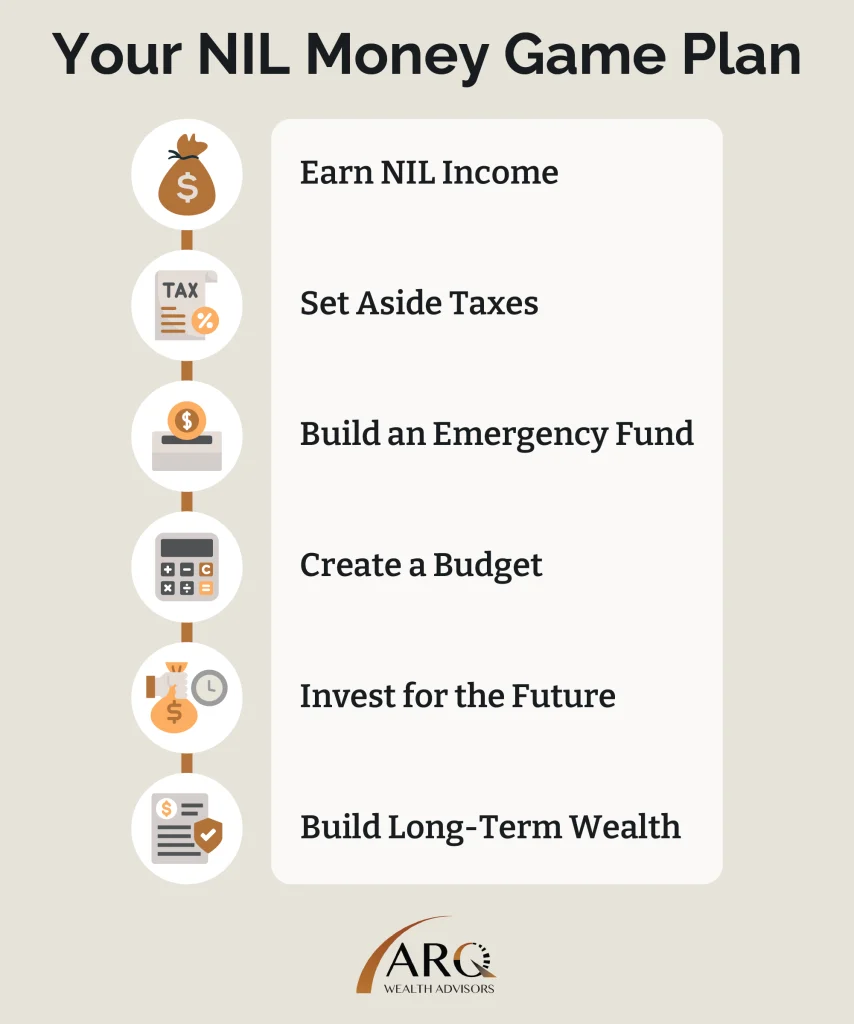
Building a Foundation For Financial Success
Filing taxes and remaining compliant are just one aspect of earning NIL income. But the amazing news is that NIL earnings allow student-athletes to create a foundation for financial success much earlier than most people.
Budgeting Around a Tight Earnings Window
Most budgeting strategies assume that a paycheck arrives on a set two-week schedule. But that’s not always the case for NIL income, which can be much higher and more infrequent than normal. Consider implementing these strategies when your check lands:
- Set up a tax reserve account and save a set amount of each check for your tax bill.
- Give yourself a monthly allowance to help stretch each deal.
- Create an emergency fund before spending on anything discretionary.
Creating a Plan For the Future
Because NIL income is self-employment income, it also unlocks retirement vehicles that most 20-year-olds cannot access. This includes:
- Solo 401(k)
- SEP IRA
- Roth accounts
All three accounts let you invest your earnings now so that they can grow and compound over time. Opening one of these accounts and contributing regularly can be a simple way to start securing your financial future. A Solo 401(K) for instance, can lower your taxable income by $72,000, saving you north of $20,000 a year in taxes depending on your tax bracket.
Creating a Business For Yourself
One of the most strategic moves athletes can make is to establish a business entity to manage their earnings. There are two common business entities athletes use:
- Limited Liability Company (LLC): A single-member LLC is a business entity that creates a legal barrier protecting you personally from any legal issues that may arise. If you operate an LLC, your personal assets are protected, and your share of the LLC’s taxable income passes through to you and is reported on your personal return. They are common and fairly easy to set up, but they do not generally reduce self-employment taxes on their own.
- S-Corporation: An S-Corporation also provides liability protection and potentially offers additional tax planning opportunities. As an owner, you are required to pay yourself a reasonable salary, which is subject to payroll taxes. Any remaining profits can generally be distributed as shareholder distributions, which are not subject to self-employment tax. For those earning significant profits, this structure can potentially reduce payroll taxes, though it comes with additional administrative requirements, payroll reporting, and compliance costs.
Assemble a Team That Talks to Each Other
Successful NIL management sometimes requires four different professionals:
- An agent who negotiates deals and finds opportunities.
- An attorney who reviews contracts before signature: exclusivity clauses, term length, morality provisions, and IP assignment (some agencies are attorneys or have in-house ones).
- An accountant who files the returns and calculates estimated payments.
- A financial advisor who sits at the center and ensures that the athlete’s biggest financial goals are being met.
One major benefit of working with a financial advisor is that they can act as the hub of your financial team and take on tasks like coordinating with your agent, discussing strategies with your tax professional, and speaking with your estate attorney so the pieces work together rather than against each other.
Build Your NIL Plan With ARQ Wealth
NIL finance has created unprecedented opportunities for both athletes and their families to monetize talents that were previously rewarded only with scholarship funds. However, the size and volume of NIL income can often be overwhelming for families who may not be prepared to handle it. This is why bringing on a financial advisor is one of the smartest moves you can make.
ARQ Wealth is a team of financial advisors based in Scottsdale, Arizona. As a fee-only fiduciary firm, we do not earn compensation from selling products, allowing us to focus solely on each athlete’s best interests. We also coordinate with any CPAs, agents, or attorneys who may be part of your team.
Schedule a free consultation with ARQ Wealth today if you’re interested in finding a financial advisor for athletes to start managing your NIL income.
Frequently Asked Questions About NIL
Do I have to pay taxes on NIL money if I never received a 1099?
Yes. You owe tax on all of your NIL income, whether or not a company sends you a 1099 form. The $600 figure people mention is just the threshold for when a payer has to issue the form — it has nothing to do with whether the income is taxable. That includes the fair market value of noncash compensation, such as merchandise, gear, or a vehicle.
How much of my NIL income should I set aside for taxes?
A common working figure is 25% to 30% of your income, assuming you are paid as an independent contractor. The exact amount depends on your tax bracket, state, and deductible expenses.
Should I form an LLC for my NIL income?
An LLC is generally considered a good idea because it protects you from any legal liability. An S-Corp election can also provide additional tax benefits, although the requirements become more complicated.
Will I owe taxes in other states?
If you compete or earn income outside of your home state, likely yes. Forty-one states plus Washington, D.C., currently impose income tax on nonresident athletes, so if you compete in these states, you will be required to pay state taxes.